"AI in capital projects is not about replacing your controls team. It is about giving them back the hours they spend on work that should not require a human."
AI is not coming to capital projects. It is already here.
Project controls teams are using it to write formulas faster, summarize reports, flag schedule anomalies, and pull insights from data that would have taken days to compile manually. The question is no longer whether AI belongs in this space. The question is who is actually equipped to implement it well.
This post is for capital program owners, PMO leads, and controls professionals who are evaluating what AI can do for their organization and who should help them get there.
What AI Implementation Actually Means in Capital Projects
There is a lot of noise around AI right now, and much of it does not translate cleanly to the capital projects world. AI is not a button you press to get a better schedule. It is not a replacement for experienced project controls professionals. And buying a software license with AI in the marketing copy is not the same as implementing AI in a meaningful way.
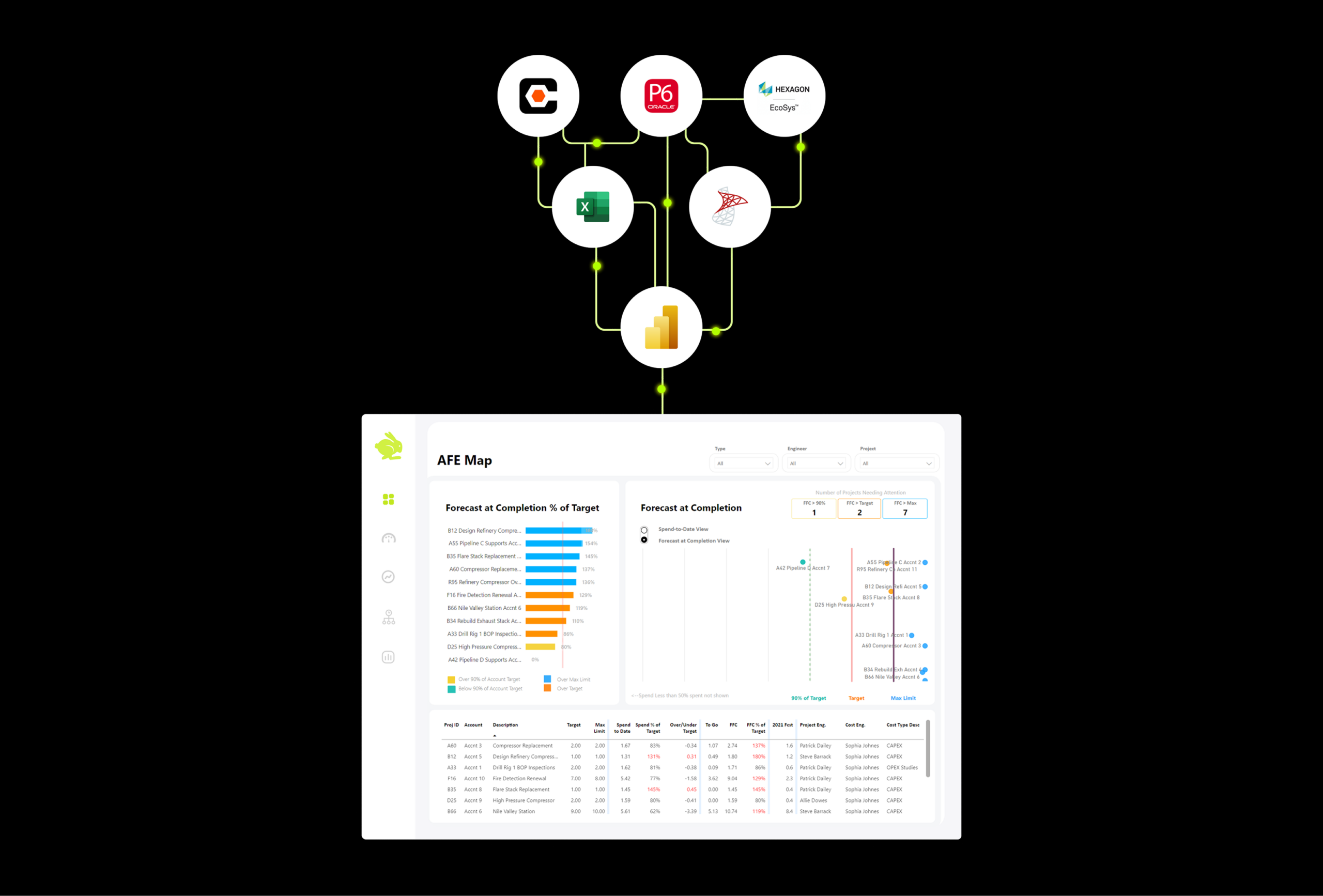
Real AI implementation in capital projects looks like this. It looks like natural language interfaces that let a project manager ask a question about budget variance and get an accurate answer in seconds instead of waiting for a report. It looks like automated anomaly detection that flags when a cost code is trending toward overrun before it becomes a problem. It looks like AI-assisted data cleaning that takes messy exports from P6, SAP, and Procore and structures them without weeks of manual work.
These are practical applications that save real time and improve real decisions. They also require a foundation of good data infrastructure before they can work. AI applied to bad data produces confident-sounding wrong answers, which is worse than no AI at all.
Why Industry Knowledge Matters More Than AI Expertise
There are plenty of firms that understand AI. There are far fewer that understand AI and capital project controls.
The implementation challenge in this industry is not technical in isolation. It is technical and domain-specific at the same time. Getting AI to summarize a project status report correctly requires knowing what belongs in a project status report. Getting AI to flag a schedule risk requires knowing what a meaningful schedule risk looks like versus normal float consumption. Getting AI to answer questions about cost performance requires a data model that reflects how capital projects actually track cost.
A firm with strong AI capability but no project controls background will build you something that works in a demo and falls apart in practice. The edge cases in capital project data are not edge cases to experienced controls professionals. They are the normal operating reality.
The right implementation partner brings both. That combination is what determines whether you end up with something your team uses every day or something that gets quietly abandoned three months after go-live.
What to Look for When Evaluating Partners
A few things worth examining before you commit to anyone for this work.
Ask whether they have built reporting and data systems specifically for capital projects, not just for general enterprise clients. The data complexity in this industry is specific enough that general experience does not transfer as well as it should.
Ask how they approach the data layer before the AI layer. Any honest answer will start with data quality and integration. If a firm leads with the AI and glosses over the infrastructure, that is a signal.
Ask for examples of AI-powered workflows they have built for clients in construction or capital programs. Not case studies written by marketing. Actual examples of what the output looks like and how the team uses it.
And ask what happens after implementation. AI systems need maintenance as source data changes, as tools get updated, and as reporting requirements evolve. A partner who disappears after delivery is not really a partner.
Where Queryon Fits
Queryon is a capital project analytics and consulting firm. We have spent years building data infrastructure and Power BI reporting systems for construction and capital program clients, and we have integrated AI into both our own workflows and the solutions we deliver.
We use tools like Claude in our day-to-day work, which means our team moves faster and builds better without the overhead that slows most engagements down. We also build AI-assisted reporting features directly into client solutions, letting project teams ask questions of their data in plain language and get accurate answers without waiting on a report cycle.
What we do not do is apply AI on top of a broken data foundation and call it a solution. Every engagement starts with understanding the data, cleaning it, and structuring it correctly. The AI layer comes after that foundation is solid, which is what makes it actually work.
If you are evaluating AI implementation for your capital program and want to talk to a team that understands both sides of that work, that is exactly what we are here for.